How to Calculate Margin of Error Easy Way
What is the Margin of Error?
The margin of Error is a statistical expression that is used to determine the percentage point by which the result arrived will differ from the value of the entire population, and it is calculated by dividing the standard deviation of the population by the sample size and lastly multiplying the resultant with the critical factor.
A higher error indicates a high chance that the result of the sample reported may not be the true reflection of the whole population.
Table of contents
- What is the Margin of Error?
- The margin of Error Formula
- The margin of Error Calculation (Step by Step)
- Example
- The margin of Error Calculator
- Relevance and Uses
- Recommended Articles
The margin of Error Formula
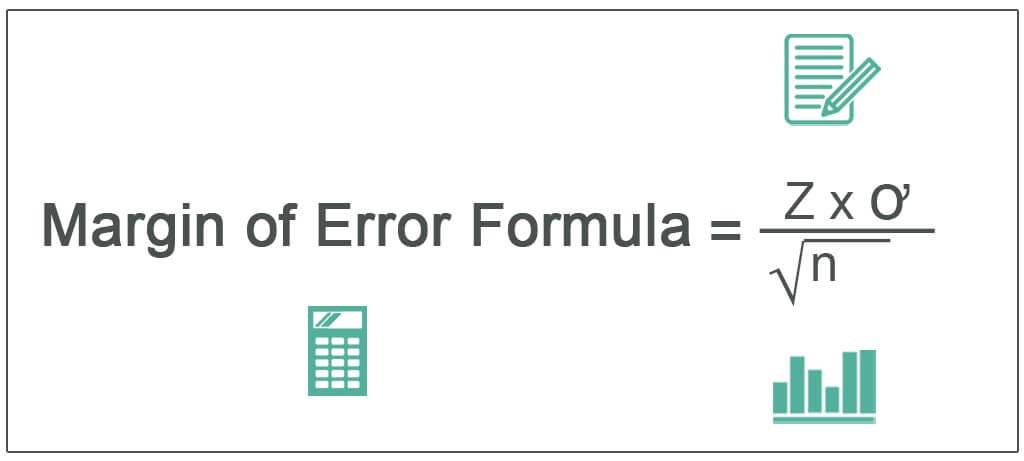
The formula for the margin of error is calculated by multiplying a critical factor (for a certain confidence level) with the population standard deviation. Then the result is divided by the square root of the number of observations in the sample.
Mathematically, it is represented as,
Margin of Error = Z * ơ / √n
You are free to use this image on your website, templates, etc, Please provide us with an attribution link Article Link to be Hyperlinked
For eg:
Source: Margin of Error (wallstreetmojo.com)
where
- z = critical factor
- ơ = population standard deviation
- n = sample size
The margin of Error Calculation (Step by Step)
Follow the below steps:
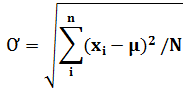
- Firstly, gather the statistical observations to form a data set called the population. Now, calculate the mean of the population. Next, compute the population standard deviation based on each observation, the population means, and the number of observations of the population, as shown below.
- Next, determine the number of observations in the sample, denoted by n. Remember that sample size is less than equal to the total population, i.e., n ≤ N.
- Next, determine the critical factor or the z-score The Z-score of raw data refers to the score generated by measuring how many standard deviations above or below the population mean the data, which helps test the hypothesis under consideration. In other words, it is the distance of a data point from the population mean that is expressed as a multiple of the standard deviation. read more based on the desired confidence level, and it is denoted by z.
- Next, finally, the margin error is calculated by multiplying the critical factor for the desired confidence level and the population standard deviation, and then the result is divided by the square root of the sample size as shown above.
Example
You can download this Margin of Error Formula Excel Template here – Margin of Error Formula Excel Template
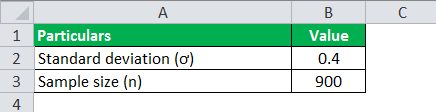
Let us take the example of 900 students who were part of a survey, and it was found that the average GPA of the population was 2.7, with a population standard deviation of 0.4. Calculate the margin of error for
- 90% confidence level
- 95% confidence level
- 98% confidence level
- 99% confidence level
We are going to use the following data for the calculation.
For a 90% Confidence Level
For a 90% confidence level, the critical factor or z-value is 1.645 i.e. z = 1.645
Therefore, the error at a 90% confidence level can be made using above the formula as,
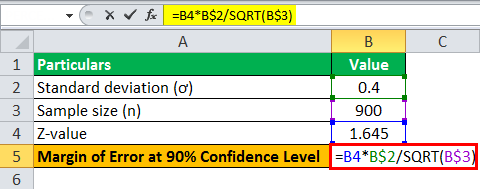
- = 1.645 * 0.4 / √900
Margin Error at 90% confidence level will be-
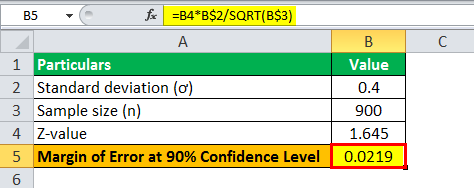
- Error = 0.0219
For a 95% Confidence Level
For a 95% confidence level, the critical factor or z-value is 1.96 i.e. z = 1.96
Therefore, the calculation of margin of error at a 95% confidence level can be done using the above the formula as,
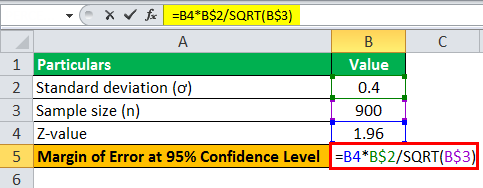
- = 1.96 * 0.4 / √900
Margin Error at 95% confidence level will be-
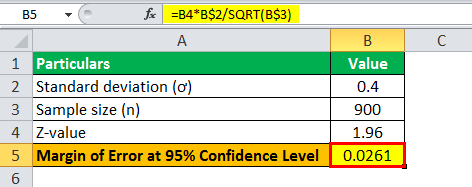
- Error = 0.0261
For a 98% confidence level
For a 98% confidence level, the critical factor or z-value is 2.33 i.e. z = 2.33
Therefore, the calculation of margin of error at a 98% confidence level can be done using the above the formula as,
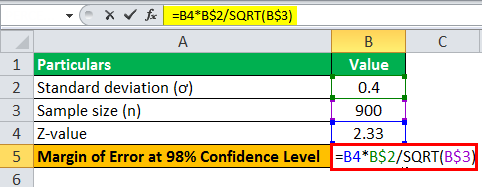
- = 2.33 * 0.4 / √900
Margin Error at 98% confidence level will be-
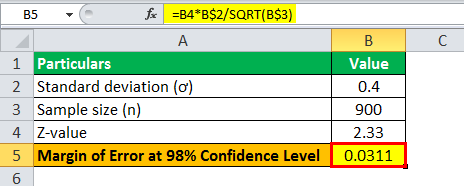
- Error = 0.0311
Therefore, the error for the sample at 98% confidence level is 0.0311.
For a 99% confidence level
For a 99% confidence level, the critical factor or z-value is 2.58 i.e. z = 2.58
Therefore, the calculation of margin at a 99% confidence level can be done using the above the formula as,
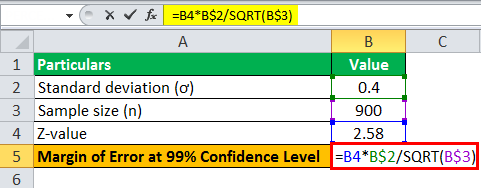
- = 2.58 * 0.4 / √900
Margin Error at 99% confidence level will be-
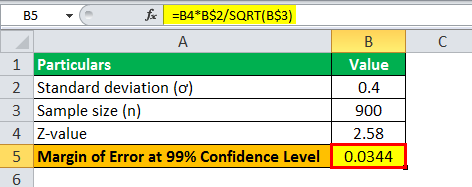
- Error = 0.0344
Consequently, it can be seen that the error of a sample increases with the increase in confidence level.
The margin of Error Calculator
You can use the following calculator.
| z | |
| σ | |
| n | |
| Margin of Error Formula = | |
| Margin of Error Formula = | |
Relevance and Uses
The margin of error equation can be seen as a way of measuring the effectiveness of the survey. It is essential to understand this concept because it indicates how much one can expect that survey results reflect the true view of the overall population. It should be kept in mind that a survey uses a smaller group of people (also known as survey respondents) to represent a much larger population (also known as the target market A target market consists of different groups of individuals, households, and organizations towards which a company aims to offer its products and services. read more . A higher margin indicates that the survey results may stray from the actual views of the total population. On the other hand, a smaller margin indicates that the results are close to the true reflection of the total population, which builds more confidence in the survey.
Recommended Articles
This has been a guide to the Margin of Error and its definition. Here we learn how to calculate the Margin of Error using its formula along with practical examples and a downloadable excel template. You can learn more about financial analysis from the following articles –
- How to Use Standard Deviation Formula in Excel? The standard deviation shows the variability of the data values from the mean (average). In Excel, the STDEV and STDEV.S calculate sample standard deviation while STDEVP and STDEV.P calculate population standard deviation. STDEV is available in Excel 2007 and the previous versions. However, STDEV.P and STDEV.S are only available in Excel 2010 and subsequent versions. read more
- Random vs. Systematic Error Where an error doesn't have any specific pattern of occurrence, it is known as random error, whereas a systematic error is an error that may occur due to any mistake in the instrument measuring the error or mistake in using the instrument by the experimenter. read more
- Sampling Error Formula The sampling error formula is used to calculate statistical error that occurs when the person conducting the test doesn't select a sample that represents the whole population under consideration. Formula for sampling error = Z x (σ /√n) read more
- Formula Percentage error formula is calculated as the difference between the estimated number and the actual number in comparison to the actual number and is expressed as a percentage, to put it in other words, it is simply the difference between what is the real number and the assumed number in a percentage format. read more of Percent Error Percentage error formula is calculated as the difference between the estimated number and the actual number in comparison to the actual number and is expressed as a percentage, to put it in other words, it is simply the difference between what is the real number and the assumed number in a percentage format. read more
- Mortgage Interest Deduction Mortgage interest deduction refers to the decrease in taxable income allowed to the homeowners for their interest on a home loan (taken for purchase or construction of the house) or any borrowings for house repair or improvement. read more
Source: https://www.wallstreetmojo.com/margin-of-error-formula/
0 Response to "How to Calculate Margin of Error Easy Way"
Post a Comment